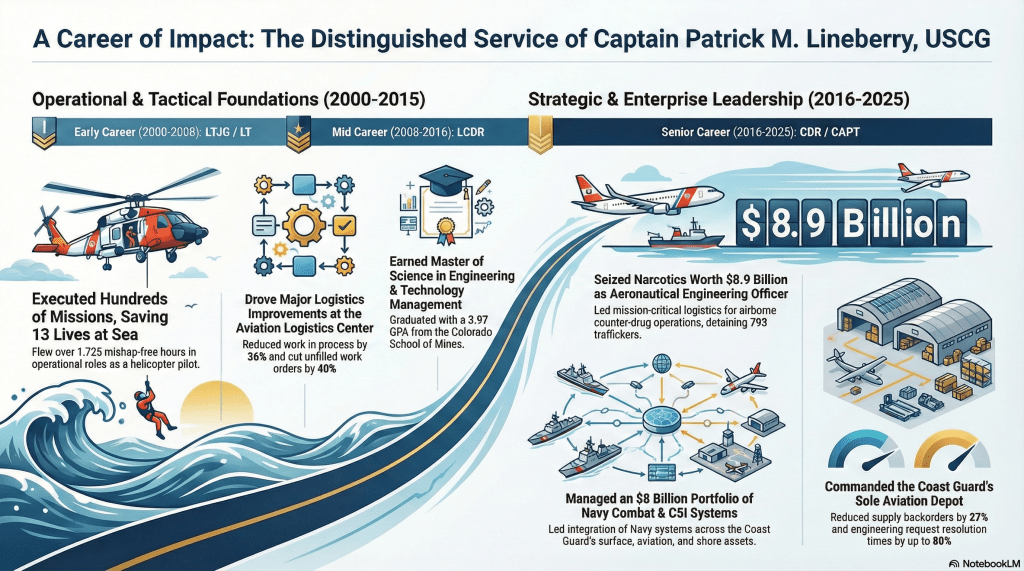
A year ago, I was responsible for a 2,000-person aviation industrial complex spanning Coast Guard aviation depot maintenance, engineering support, supply chain management, information systems, and procurement. By my count, we integrated the competing priorities of seven paying programs, eleven technical authorities, and twenty-five air stations — the what, the how, and the who.
Today, my responsibility is defined by a statement of work and focused on a single aircraft program.
I expected the narrower role to feel smaller. Instead, I am learning that it may require a different kind of growth: less breadth, more depth; less authority, more influence; less motion, more progress.
Breadth built the foundation
“I came to see the advantage, when developing leadership skills, of seeking a breadth of experiences, rather than pursuing the tempting path of early specialization.”
— General Stanley McChrystal, My Share of the Task
For 25 years, I received an annual performance evaluation that specifically addressed my ability to “assume greater leadership roles and responsibilities.” I began as an individual contributor, trained to identify problems and resolve them but was soon drawn to the camaraderie of the hangar deck. I specialized in maintenance/logistics to be part of it and while many of my peers remained responsible for themselves, I now led people and managed a budget. My sense of purpose grew beyond executing the mission to supporting it.
In the middle of my career, the work became less about doing everything and more about deciding what could safely remain undone. Twenty-four hour search and rescue duty. Team coordination meetings. Training flights. Grounded aircraft response. Deployments. Administration. Family! There was always more work than time in the day and I frequently shifted from one context to another. My focus had grown from solving today’s problems to managing future risk across a system. In order to do that effectively, I required an understanding of not only my responsibilities but also others.
The late stage of my career featured decisions made through subordinate leaders. Thus, my focus shifted to managing a culture that did the things I used to do. Difficult issues abounded, but were resolved by others and briefed later to me. Risk was now discussed in strategic terms to guide supervisor decisions, and the details monitored through lagging metrics. The volume and variety of responsibilities presented a constant need to balance trusting now and verifying later. Every day was a tension between today’s details and tomorrow’s trends.
Each assignment asked: Can you lead more people, handle more complexity, carry more responsibility, and operate at a higher level of consequence? I absolutely loved it.
Narrowness enables depth
It’s depth you need; you get narrowness as a byproduct of optimizing for depth (and speed).
— Paul Graham
It’s been one year since retiring from active duty. I find myself simultaneously enjoying and still becoming comfortable with my current role. On the one hand, I enjoy the autonomy and not bringing work home with me. After four months, I noticed that my stress level had dropped. On the other, my muscle memory is to continue seeking responsibility, understanding the whole, and finding a clear vision within chaos. I sometimes feel guilty for being less “busy” than those I work with.
There are of course meetings, but my role is different. I’m no longer the one delivering or receiving the content, eliminating the desire to perform. I develop the agenda, facilitate the discussion, and process the minutes. I’m better able to read the faces in the room, knowing when to speak and when to keep quiet, when to support a real-time response by a teammate, and when to follow up later personally. Sometimes depth means recognizing the unstated context behind a meeting comment. Sometimes it means focusing the agenda before the meeting starts. Sometimes it means helping the team avoid solving the wrong problem quickly.
I now have more time to think before applying three decades of experience at a precise point of leverage. I love the insights that come though deep thought, but am still prone to filling the silence with busyness.
Depth increases value creation
“Specialists have less competition and stress, but only in times of stability. Generalists face a greater day-to-day challenge for resources and survival but have more flexibility to respond when times change.”
— Shane Parrish
Senior leadership creates a paradox: broader responsibility increases influence, but it can reduce the time available to understand any one problem deeply. On the flip side, specialization without broader systems awareness can lead to local optimization. My next stage may be learning to combine both: using breadth to understand the system and depth to improve the specific piece in front of me.
The Coast Guard trained me to keep expanding my leadership scope: larger teams, broader impact, more responsibility. That culminated in command of a 2,000-person aviation industrial complex. My post-active duty transition has required a different kind of growth: going deeper into a narrower problem space where expertise, judgment, and relationships can create leverage.
I am still learning to measure my job satisfaction less by the size and complexity of the organization under me and more by the quality of my contribution to the individual in front of me, regardless of their positional. But the responsibility has not disappeared; it has only changed form.
I am still solving problems. More than ever, I am learning to do it through influence instead of authority.


Leave a Reply