Artificial intelligence (AI) and large language models (LLMs) have become an integral part of my day since the spring. I’ve consumed dozens of videos. I have spent hours listening to podcasts. I experienced both disappointments and surprises. I completed courses. I even reinstated my LLC as AI-centric. As these tools—along with their capabilities and user interfaces—continuously evolve, my thinking has evolved alongside them.
My family, friends, and coworkers have increasingly asked for advice on AI. My wife has lovingly called me iPat for at least ten years, but only recently did I accept the title. My former executive director roasted me this summer as both a management wonk and PatGPT. Nonetheless, this isn’t a technical review. Instead, I’m sharing my personal journey with AI while offering guidance for my kids.
Avoid the hype
Finding nuanced perspectives on artificial intelligence is hard.
Technologists would have you believe it’s only rational to invest hundreds of billions of dollars in data centers. Meanwhile, there are documented effects on individuals and growing impacts on the environment. Furthermore, the introduction of the efficient DeepSeek and incremental ChatGPT-5 upended many earlier assumptions. We are learning in real time how to coexist with rapidly evolving technology.
I’ve personally found Professor Ethan Mollick’s blog offers the most balanced perspective on AI. As my therapist says, a healthy person can hold two contradictory feelings at the same time. AI can be both scary and useful. It can be used to spread misinformation at scale and point doctors to anomalies in medical images. I’m unsure if Skynet will become self-aware. Still, I want humans in the United States to keep an AI competitive advantage.
From AI Novice to Fractional AI-BizOps Consultant
I upgraded my cell phone over the winter for two reasons. First, it was an iPhone 12. Second, I wanted Apple Intelligence. I was sold on the promise of cross-app context and a more agentic Siri. I eagerly enabled ChatGPT and surprised, found I already had an account. Despite its failings, I had officially become an AI novice.
You know that phenomenon where after learning something new, you start noticing it everywhere? I quickly began spotting Gemini results in my Google searches. Gradually, my search behavior evolved as I shifted cognitive load to the model. My reading and listening habits remained the same. Yet, they naturally began featuring more AI-related content and I switched to an AI-embedded podcast player.
At work, I began experimenting with AI despite the challenges posed by government cybersecurity protocols. I used it increasingly for summarizing lengthy documents and creating crappy first drafts. People much younger than me developed surprisingly good AI tools to draft formatted awards and evaluations. I was asked to give a lunch talk about my personal knowledge management and use of AI. Though I can’t quantify the time saved, the learning experience proved valuable.
My understanding of AI and its use increased step-wise through two courses. Together, they revealed the power of strategically managed context knowledge: Tiago Forte’s Second Brain Enterprise and Anthropic’s AI-Fluency.
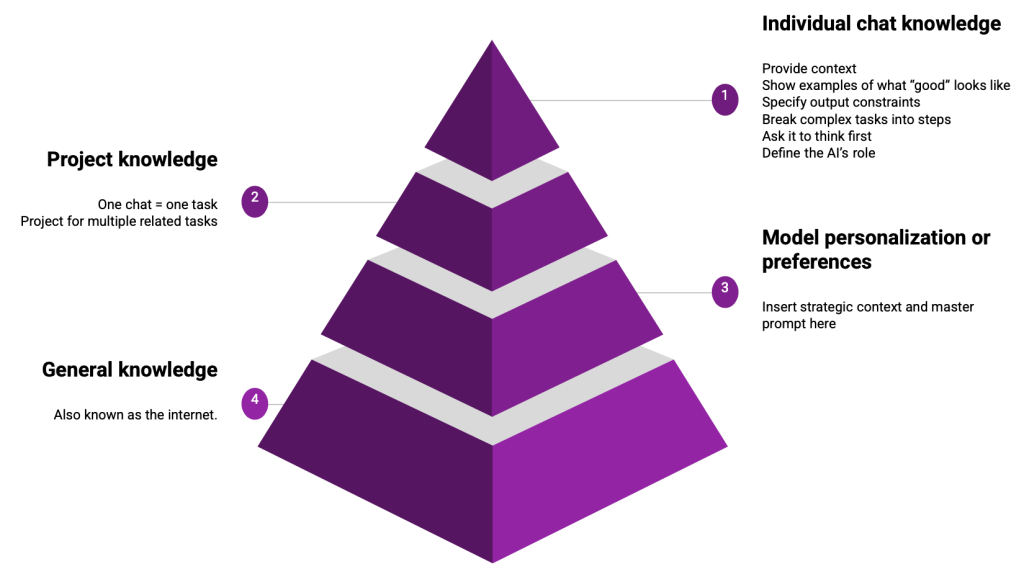
Oh, I should mention that I retired in June and began job hunting in July. Super good timing, but three months of terminal leave provided plenty of time for learning something new. I planned only a JavaScript course to improve my use of Notion. But, I ended up taking a three month technology sabbatical.
I created a personal strategic context and master prompt through CustomGPTs. I added them to Claude, along with my master resume and various career goals. Over 41 applications, I refined my approach—adjusting at least one level of context. I also learned to leverage Claude for deep company research. For interview preparation, five minutes of AI tokens synthesized information from hundreds of websites and provided interesting questions to consider. Creating a tailored resume and cover letter took 90 minutes in April. Now, it takes just 30 and is a much better product.
I’d love to tell you that AI crafted the perfect application, which then led to the perfect job offer. As I mentioned earlier, we should avoid the hype.
AI came up in roughly 75% of my job interviews. Those that know me also know that workflow came up in 100% of my interviews. My job search taught me to reframe this passion as “business operations improvement.” Inject some technology, and you have the emerging field of AI-operations.
Ultimately, one company offered me 1099 work modernizing their internal operations, including the integration of AI. So yes, artificial intelligence did help me land a job—just not in the way I had expected.
Advice to my kids
Okay, enough about me. What about you?
Here are three tips that I think stand the test of time:
- Remember that technology companies probably don’t have your best interests in mind. I agree with Eli Goldratt that the goal of every business is to be profitable now and into the future. And I don’t fault them for that, but I do hope their algorithms include noble purposes.
- Personal fit matters more than performance metrics for the vast majority of users. Some focus on the user interface like my wife. Some on integration with Google or Microsoft like my friends. Some prefer voice interaction like my daughter. Coding capabilities are important to my son and context knowledge management to me. Each model’s tuning and user experience is unique, so experiment. I was a Claude fan, but now prefer ChatGPT and NotebookLM.
- Lastly, embrace the journey! No single prediction about AI’s future is accurate, though collectively they are useful. Automation will displace some work while creating new opportunities. Still, you can learn to partner with AI as a co-intelligence today. Just don’t outsource all your critical thinking.
 Patience and Humility
Leave a comment