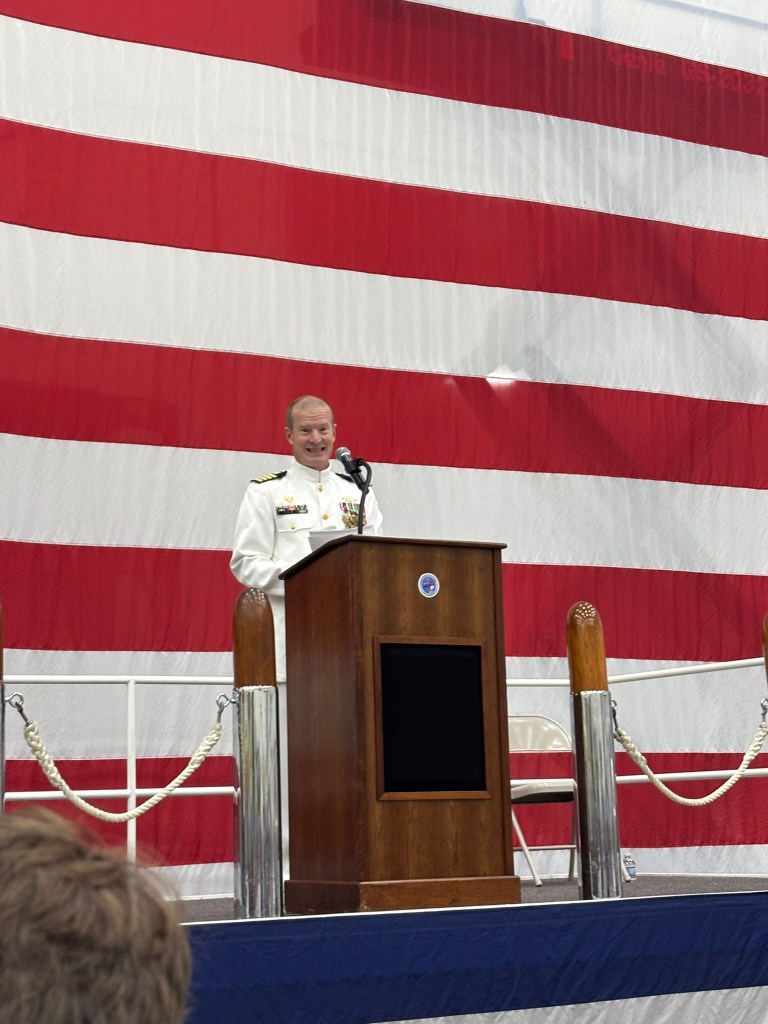
In 2016, Danny Hale has challenged me to do more than just leave notes for my replacement. Each iteration has prompted deep reflection on the key lessons learned, evolving from issue papers to this blog post. They aren’t simply handoffs of unfinished work—they’re invitations to question the status quo. They leave opportunities for those who stay to push things onward. Some ideas I couldn’t quite bring to fruition, while others only became clear to me in hindsight.
I contemplated writing this edition about my entire Coast Guard career, but will reserve that for my retirement speech. Instead, I’ll focus on my time as the Commanding Officer of the Aviation Logistics Center (ALC). What I consider it my dream job, thus far.
What I Learned
First, leading 2,000 people across sixteen reporting chains and three HR systems is hard! Processes spanned depot maintenance, supply chain management, engineering support, information systems, and procurement. But this experience revealed a clear truth: ALC’s culture has a bias for productivity. During my two years we faced cost, schedule, and performance accusations spanning from mismanagement to fraud. While the informal ones were easily dismissed, the formal required independent external investigation. Each review confirmed that, though imperfect like all humans, we operated within policy as we strove to improve system throughput. If anything, we had not considered the second or third order impacts.
Yet, this bias was often tempered by the complexity of reality and our performance management system. The first invites those with high positional authority to offer well-intentioned opinions. The second rewards individual rather than collective achievement. Together, both dynamics then lead to optimizing local outcomes at the expense of global ones. We encountered unforeseen issues. Earlier assumptions later wound up false. I never needed to push people to work harder. I only needed to make sure we were all moving in the same direction.
Second, the maintenance of existing systems is consistently undervalued compared to new initiatives. This is understandable—new is exciting, and modern makes for a better sales pitch. It’s easier to discuss beautiful future concepts than tackle today’s ugly realities. Yet maintenance remains crucial, parts are expensive, and labor even more so.
Government acquisition programs don’t get full funding, but do often fare better than operations and sustainment. Until recently, I’ve observed stronger accountability in the acquisition phase of a system’s lifecycle. This is in comparison to the support phase, where 55-70% of total costs occur. My 60-day schedule breach for two of four new helicopters warranted a briefing to DHS leadership. Meanwhile, my $197 million funding shortfall for the remaining 200 did not. It only gained attention when aircraft were unavailable for the current border security surge.
Finally, we often become too absorbed in our own concerns when dealing with others. Sometimes this manifests as simple lack of compassion. I expected a large workforce would bring proportionate challenges with good order and discipline. We typically had 25 cases in process at any time with career implications. Most cases involved workplace conduct issues like inappropriate comments. Still, others were much more serious. These included substance abuse, domestic violence, terminal illness, and family deaths.
What Should Be Done About It?
It seems like I’m wielding my favorite tool. Still, ALC should broaden the use of Theory of Constraints (TOC) principles to all work. We wouldn’t dump parts in the middle of a hangar and expect physical workers to meet assembly targets. Yet, we flood knowledge workers with unstructured emails, chats, and notifications daily. We still expect peak performance from them.
Consider this example: An airplane needs an engine. This triggers a supply chain repair work order, leading to a buy order for parts. Once the parts arrive and repairs are finished, engineering approval is required before delivery. But if the computer network for airworthiness certification is down, the airplane sits idle. As my deputy said, it’s all connected.
We began some of this work with weekly metrics. These metrics cover each of ALC’s five core business functions. They integrate performance across all divisions. Yet, we have yet to compare performance across functions. We also have not systematically applied TOC’s five focusing steps as a means to increase throughput within each. We stay too comfortable moving work to the people we have instead of people to the highest priority work.
We must also strengthen our culture of documentation. Skeptics will yell, “Less government bureaucracy!” I am not advocating for unread PDFs or outdated procedures. I’m also not advocating for buried desk guides—like the 118 I inherited. Instead, every employee deserves clear, accessible expectations they can help improve. This creates a flywheel effect: tribal knowledge gets captured, best practices emerge, and we build a foundation for innovation. It’s the natural progression from ancient libraries to encyclopedias to Wikipedia. AI is now improving work coordination to free up time for actual execution.
Finally, we must recognize each group’s contribution to our value chain. Watching a freshly overhauled helicopter or airplane take flight seems more exciting. Nevertheless, reviewing cybersecurity logs is equally important. Both tasks represent vital work by skilled experts. Younger employees bring in new ideas that are filtered through older employee experience. Let’s focus on what people bring each day, not what they don’t. Healthy competition and constructive friction serve us well—but we must guard against low-quality thinking. Remember—not everyone you pass in the hallway is having a good day. Show some grace.
 Patience and Humility
Leave a comment